Monday, 30 September 2013

How to make a curtain for a cubby hole or shelves.

As Summer draws to a close more of our customers have been talking about house hold sewing projects that they have been putting off until the nights have drawn in. Many are currently lining their curtains to help stop drafts and to cut down on their  heating bills. Some people spoke of making their rooms look tidier by placing simple curtains over cubby holes or shelves.  These curtains are often held in place with the same wire as net curtains. There are many fabrics  that are suitable for a project like this, from the classic Gingham fabric to cotton prints and satin. I decided to make a satin curtain with an organza over lay to add a little sparkle.

You will need;

Fabric (I used Satin  and organza)
Pins
Thread
Needle
Scissors

Step One. Measure and cut your fabric.

The cuby hole I am covering is 60cm by 135cm. I want my curtains to have a bit of fullness and so I am making two curtains that are 45 cm wide.
I cut out two rectangles of 49cm by 145cm to allow for hems and seams. I then used these as a template to cut out the organza.


Step Two. Hem the satin and the organza panels.

Normally we hem things towards the end of construction, but for this method we need to hem first. A chequered pattern on your ironing board is a real help in making sure your hems are neat and even. To hem fold the edge of the fabric towards the wrong side of the fabric, press and then fold the fabric again. Stitch in place.


Step Three. Baste the organza to the satin.

A basting stitch is a long stitch that is not seen in the final product. Basting stitches are used to reinforce a section of a garment that may get placed under strain, such as an arm hole, or to hold two or more pieces of fabric together as they are manipulated.

Place the WRONG side of the organza (the side which has the hem  folded up on it) on top of the RIGHT side of the satin.  Pin the fabrics together along the long edge and paste with a small seam allowance (I used 5mm). Even though the stitch won't be seen it is still a good idea to make the seam as neat as possible.  Repeat  on the other side and on the second curtain.

Step Three.  Hem the sides.

Hem the sides of the curtains in the same way as the bottom of the curtains but with  narrower hem (in this case I  used 5mm). The hemming is made much easier by basting the two layers of fabric together first. Many people try to skip the basting phase of construction. However basting only takes a few minutes and really makes the future steps of construction easier, quicker and neater.

Step Four.  Make a casing for the wire.

A casing for the wire can be made in exactly the same way as the lower hem. However when folding over the fabric measure the curtains to make sure they are of the right length.

A simple curtain that you can put together very quickly. Whilst I love my books a curtain like this can help make a more cluttered book shelf look neater (such as a shelf full of files or reports).

Have a look around your home and see what other quick sewing projects you can complete to enrich your surroundings.


Saturday, 14 September 2013

So what is this Steampunk on your website?

The eagle eyed visiting our website may notice a new section under "Fashion Fabrics". We now have a "Steampunk  and Alternative fabrics" section. So what is Steampunk and what is Alternative?

If you ask 10  Steampunks to describe what steampunk is you will probably get 10 answers.  For me the best description is "A Victorian's vision of the future". The Victorians had no idea of aeroplanes but they knew of balloons and were working on the fundamentals of Airships.  So in the Steampunk world we may find airship pirates for example. With this vision in mind people have created amazing fashion, literature and music.


  • So what makes a fabric Steampunk?  Just about any fabric can be used in any context, but there are some fabrics that just scream out to be used in a Steampunk creation. Metallic fabrics are popular as are the more natural colours such as brown, olive, cream and so on. (there is a little joke in the community that Steampunks are Goths who have discovered the colour brown).
This Bella Angelic would make a stunning skirt or long coat for example. 


Fabrics with patterns from the Victorian era are also often used in steampunk couture. Paisleys and stripes can add a classical touch to any clothing project, such as this "Spice Trail" design in nutmeg.


Map Fabrics can be inspiring in any design. Some of the best projects take fabrics and use them in ways not originally envision, such as this furnishing fabric. 


Other times you may wish to use a scene or vista that inspired by the technology and industry of the Victorian era. For example this vintage hot air balloon fabric.

Ultimately it is not what you use  but how you use it. Mix and match, take chances and explore. 

We intend to expand on the idea of grouping fabrics together as time continues. Maybe a re-enactment section or a LARP section? What sections would you like to find on the Fabric8 website?


Saturday, 31 August 2013

Back to School

For the first time in a while the Summer holidays actually felt like they took place in Summer.  With luck the kids going back to school next week will be taking their first steps into a whole new adventure. If they are lucky enough to be taught textiles there may be a few things it's worth packing them to school with.
  Tailors Chalk in a handy hard plastic case. Having multiple colours really helps when tracing out a pattern. One colour can be the seam, the other darts the other pockets and so on. Having your own means not having to wait for the class chalk to come around.


A tape measure is always handy in class. Small and easy to carry and yet will again save you having to wait for the class tape to come around.


Wundaweb Instant hemming tape .Beloved by Gok Wan and anyone with shorter than expected legs. Perfect for taking up school uniforms but not so permanent that they can't be let down as the kids grow.


Labelling pen for school uniforms and P.E. Kit. Easy to use, just write as you would with a  regular pen, only this pen will not wash out.

Four very cheap and simple things that can make textile classes a little easier, or make your job of getting the uniform and kit ready for school a LOT easier.
Pop into the shop for more help and inspiration, remember we're in Colchester AND  Felixstowe.

Tuesday, 20 August 2013

Teach kids about life, teach them to sew, knit and crochet.

We are still seeing families come into Fabric8 for summer projects such as bunting.  In a week or two they'll be back for school project materials.  Over the last few years we've noticed a lot more boys come in for their school materials. Sometimes these are for courses that  are compulsory, other times they are using sewing in a technology project. Either way we think ALL children AND adults need to be able to sew or knit or crochet, or all three.

There is the obvious reasons for learning, such as being able to repair your own clothes. 

Then there is the other obvious advantage of being able to make your own clothes as well. But it doesn't have to end with just clothes, just look at the handy things you can make for around the home once you know how to sew such as Reusable Cable Ties, or Kindle or Tablet Covers.

But the reasons for teaching people to sew or knit runs deeper. Think about the skills you use when you sew, other than sewing.

To begin with you decide to make something, but what? You have to engage your brain power to work out what you want to make to begin with. Then you have to select a pattern and then you need to work out what fabrics are compatible with what you want to make. You may find you need a different pattern to make your selected garment out of a certain fabric. So you need to use decision making skills and critical thinking.

Then you need to cut out your pattern and lay out your fabric, so you have to learn to follow instructions as well as develop manual dexterity. When following your pattern you learn that things have to be done in a certain order, seams have to be done one at a time, at the right time. You may need to research a particular way of doing things, or learn how to do something new such as using interfacing. You always have to focus on what you're doing without losing sight of the over all picture, to make sure you do the right thing at the right time.

In other words teaching someone to sew teaches them a myriad of skills. So many of these skills are transferable to other projects, indeed sewing is the perfect model for project management. So even if you want your kids to grow up to work in fields other than the immediate creative ones you will be giving the a huge boost by teaching them to sew, knit or  crochet from a young age.

Friday, 9 August 2013

Sewing For Going to Festivals


I Love festivals, be they comedy, historical or musical. Every year I head to Wave Gothic Treffen in Liepzig in Germany. Being a Goth and Steam Punk festival it makes sense that sewing fanatics have a ball preparing for this festival. However you can use your sewing skills for other festivals as well.
  Many festivals these days have a theme, for instance Standon Calling had the theme of "Running away from the Circus. " Themes  like this are useful as you can fit in with just a little face paint, or you can make yourself something spectacular.

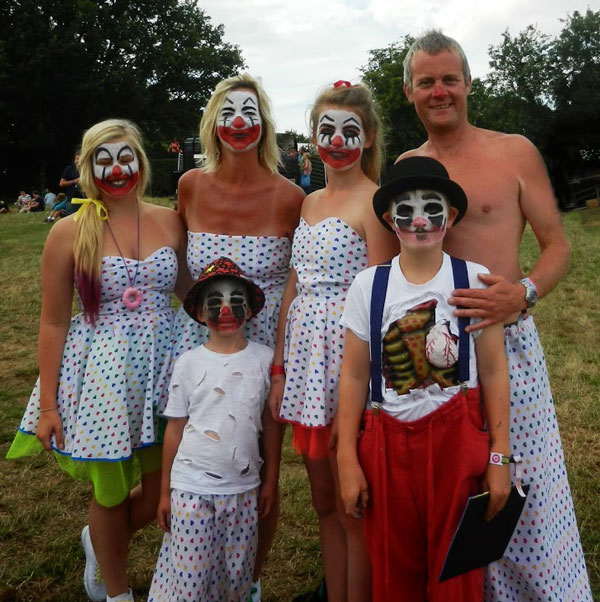
This family of escapee  clowns were costumed very easily and in affordable style with  help from this blog.
A quick petticoat pattern,
a harem pants pattern,
and a circle skirt pattern
with some dress net and polycotton and voila, a family of clowns costumed in a day.

But preparing for a festival isn't just limited to sewing costumes. Think about where you can sew a quick hidden pocket with a Velcro fastener. I put one on the inside of my shirt just large enough to keep an emergency £20 note.

You can always use fabric paints and markers to put a design onto your clothes as well.

If you're taking kids with you use a marker pen to not only write their name on their clothes labels but also your mobile number. (Speaking of phones, if you have one with a camera take a shot each morning of them in their festival gear. It's a nice memento but also you can show it  to the security guards at a festival if you get separated.).  You could easily make a comfortable wrist band out of cotton or poly cotton, fastened with Velcro with your contact info on for them to wear as well.

Remember to enjoy your festival going, aim to look fantastic, but remember you're there to have fun!


Tuesday, 30 July 2013

Fun Projects for the Holidays

The Summer holidays have begun, and in our Colchester and Felixstowe fabric and haberdashery shops have already noticed families coming in for supplies. We always love helping people out with their projects, and it's always especially nice seeing younger people enter the world of sewing, knitting and crafting. We sell handy little packs of bunting, or beginners sewing kits in the shop and would encourage anyone near Colchester or Felixstowe to pop in for a visit.

However we like to help people all over the world as well. The web shop has been down for a stock check and will be up and running soon. Until then we have our blogs to give you ideas for fun sewing projects to keep the kids (or you) entertained over the holidays.

How to make a carrier bag holder. This project is very simple to make. The tutorial explains how to make a  French seam, you don't HAVE to use a French seam but it's a handy thing to learn. It also has a very strong environmental message. You can recycle old fabric to make this project, which then helps you recycle your old carrier bags.

How to make a Kindle or Tablet cover.Many people seem to be getting all sorts of high tech gadgets. This projects teaches you how to make a protective case for kindles, tablets and other gadgets. It's also a fantastic introduction to the effects you can make with a padded case.
How to make a petticoat or Tutu.  Petticoats are not only great for a dressing up box for your own  fairy princess. Petticoats and tutu's are becoming "must have" things to wear at music festivals this year. This project teaches you how to make a petticoat which can be layered and built up over time. You can also make a VERY quick petticoat as well.

A non sewing cushion cover. Sometimes it's encouraging to make a project that is useful and beautiful without having to learn sewing first. This cushion cover just needs fleece and scissors. You can make the cover in any size, so if you don't have a cushion pad at hand you can use an old pillow. Ever wanted to get boys interested in sewing? Mix the colours of the fleece to match a favorite football or formula one team.

How to make a circle skirt.  A circle skirt does not always require a pattern. This tutorial shows you how to make a custom made circle skirt (that would fit perfectly over a petticoat). Circle skirts are fun and easy to make and show how you can use maths in the real world.

Thursday, 25 July 2013

How to make a Circle Skirt

In our last blog we showed you how to make a sarong. In keeping with the Summer theme today we present how to make a circle skirt.  I like nothing more than combining my love for sewing with my love for performing magic. (Trust me I am going somewhere with this). In magic a magician will take a trick that is mechanically easy to perform, and then use it to practice presentation. By not worrying about complicated hand movements a magician can focus on other details. It is much the same when sewing. A circle skirt is fundamentally an easy garment, which makes it the perfect garment to practice new techniques with.


The basic pattern for a circle skirt is very simple. Our blog on how to make a petticoat begins with making a very short circle skirt.
I often use brown wrapping paper or pattern making paper for my projects. However I have some wrapping paper that's been getting in my way at home, and so decided to use this for my circle skirt pattern

As with our "how to make a petticoat" tutorial we begin by making two quarter circles on the paper. The radius of the first quarter circle is the hip measurement divided by 6.28 (check out the petticoat tutorial for an explanation of the maths)

The second quarter circle is the length of the skirt from the waist circle. (the third circle in this picture was just an alternative skirt length I was playing around with).

We now have a very sparkly pattern.
Fold the fabric in half and place the straight edge of the pattern on the fold of the fabric.  On the other straight edge of the pattern add a seam allowance. This will give you the front  half of your skirt.

Place the pattern again onto the fabric, And cut out a second panel.

Right sides together pin the two panels together along the straight edges and sew.


 You now should have a full circle which will lay out flat on the floor.

All that is technically needed is a waistband and a hem.

However here is an opportunity to improve on your skills of sewing. The skirt has raw seams which we can now tidy up with bias binding.

Press the seams open, and the wrap bias binding ribbon around the raw edge of the seam. Carefully sew the ribbon onto the raw edge.

We now have beautifully bound seams. These seams not only look neater but ale stop the seam fraying, greatly increasing the lifespan of your garment.


The waistband needs to be as long as the final hip measurement you used for the circle skirt, in my case 125 cm long. Cut out a strip of fabric to this length and make it four times the width you'f like the waistband to end up (I use my metal ruler as a guide).


Now fold in half along the length , wrong sides together and press with an iron.
Open the fold and use the crease as a guide to fold the outer edges of the strip into the middle.

Fold it back in half again and press, this gives you what looks like large bias ribbon (but it is not on the bias).

Pin the waistband onto the circle skirt, sandwiching the circle skirt in between the fold of the fabric.

When the two ends meet stitch the strip of fabric together and THEN fold them over the circle skirt. Then stitch the waistband to the circle skirt, leaving a small gap to thread the elastic through.


Now all that remains is to hem the skirt. Circle skirts can be hard to hem however as there is always more fabric on the hem as there is just above the hem, so you have to pleat the fabric slightly as you hem.


Another option would be to use a roll hem foot. This is a sewing machine foot with a curl set in it which the fabric is fed through. This creates a tiny hem, only a few millimeters wide.
However in this case I decided to use the bias binding ribbon again. Wrap the bias around the hem and top stitch in place. Bias binding can actually bend around the curve of the hem. And much like the seams this hem will be very long lasting.


And so we have a very neat inner view of the skirt. We have taken a simple pattern and used it to try out new techniques and to improve our sewing.


And behold a very simple and flattering circle skirt. Simple to make and a great project to get to grips with a roll hem foot or bias binding. You will be able to make up one of the skirts in no time. Half the battle is in making the pattern. Once you have this you can make a skirt to match any top.


Remember to enjoy your sewing and to keep on learning.